



More than just a language
How do multilingualism and social justice influence our use of language? What barriers and opportunities does this present for education and society? Anouschka Foltz, Professor of Applied English Linguistics at the Department of English Studies and, from autumn 2026, the new Vice-Dean of the Faculty of Humanities, explores these and other questions in her research.
Language processing, multilingualism and social justice
Anouschka Foltz researches how people learn and use language, with a particular focus on English and multilingual contexts. She investigates how children and adults speak, understand and acquire new words, and how social and personal factors play a role in this process. An important part of her work is making language and education accessible to all, particularly for people from disadvantaged groups.
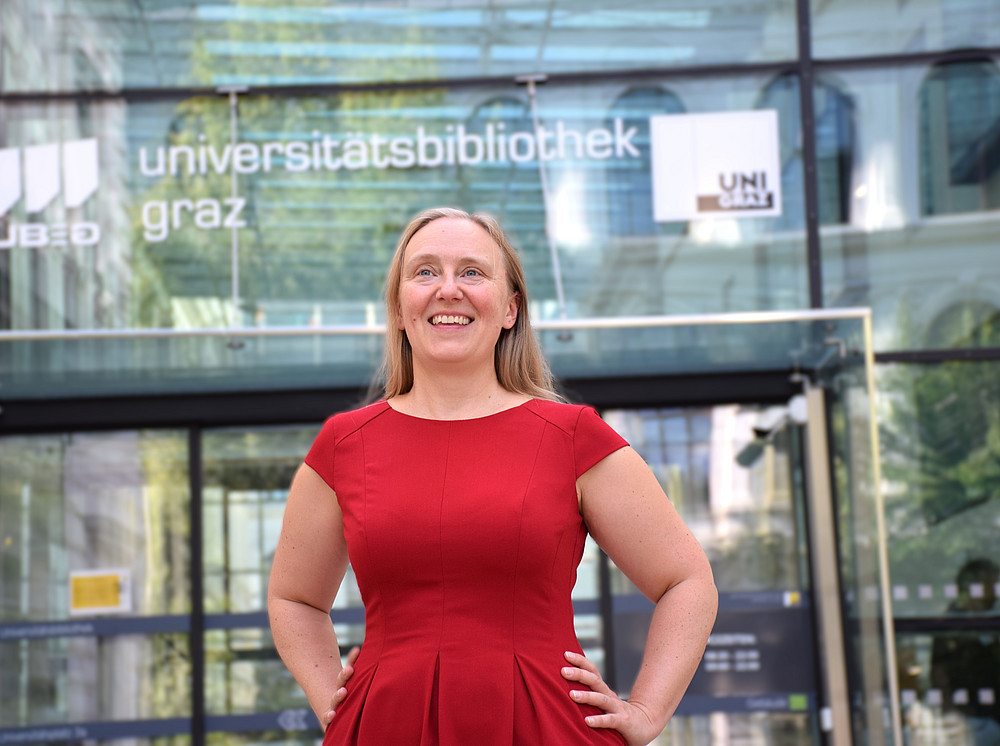
Ms Foltz is currently also investigating the different varieties of English (e.g. British English, American English, Australian English and Singaporean English) and how learners perceive the differences between them. In doing so, she is exploring questions such as: What is considered correct, and why? What influences our perception of which language variant we classify as ‘correct’, and how does this affect teaching in Austrian schools?
Language is a gateway to the world
Another current project by Anouschka Foltz focuses on language barriers and inclusion. In Wales, she is working with colleagues to investigate how deaf people can gain better access to health information. The aim is to improve communication between patients and healthcare staff and to provide information in British Sign Language, which, like spoken language, can vary from region to region. In Austria, too, Anouschka Foltz is investigating how multilingualism can be utilised in the classroom to support pupils from diverse linguistic backgrounds. This is because young people from migrant backgrounds are still less likely to go on to university. Yet they, too, are needed in research to accurately reflect society, ask different questions and thus tackle current challenges.
Research with social relevance
Anouschka Foltz combines her research with social engagement. She is committed to ensuring that findings from psycholinguistics – one of her main areas of research, to which she intends to devote more time in future – and applied linguistics are incorporated into education and everyday life. Her work demonstrates how important it is to view language as a resource: for individual development, equal opportunities and an inclusive society.
Anouschka Foltz is Professor of Applied English Linguistics at the Department of English Studies. Following her Master’s degree in Mannheim and a PhD in Linguistics at Ohio State University, she conducted international research on topics such as language processing, prosody and multilingualism. Her current projects focus, amongst other things, on the accessibility of language for marginalised groups and the promotion of multilingualism in education.