



What are the challenges faced by a Department Manager at the Department of Translation Studies (ITAT)?
The word ‘challenge’ often carries negative connotations, so I would like to emphasise right at the outset that I view the word in a very positive light when it comes to my work at the ITAT.
The ITAT is a well-staffed and diverse institute; including lecturers, there are currently 119 people from different linguistic and cultural backgrounds employed here. I deal with most of them on a regular basis, as my remit covers all budget management (including third-party funded projects) and all HR matters, from the job advertisement right through to the actual appointment. I work extensively with SAP, a system that was actually a challenge at the outset in the conventional – that is, rather negative – sense, but which I have since come to appreciate. I see the different perspectives – both positive and negative – of the people I meet in the course of my work as the most positive challenge of all, and they are the ones I would least like to do without.
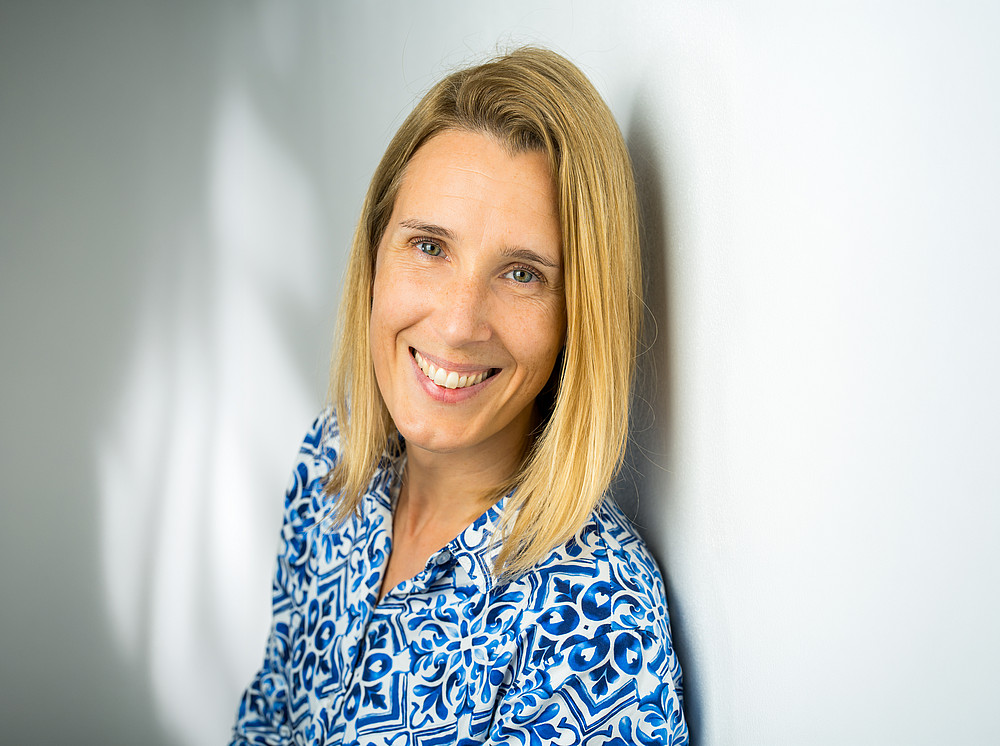
You studied archaeology yourself and have also published work in that field – has your love for your own field of study remained?
For practical reasons, that love has turned into an interest. I still enjoy reading articles and reports about excavations in Austria and Styria. Some of my former fellow students have made a name for themselves as independent archaeologists, and I’m always particularly pleased when I get the chance to study their published findings.
Are there any current projects or initiatives at the institute of which you are particularly proud?
We have recently completed a restructuring of the institute’s staffing and hierarchy, a process that has taken us around two years to finalise. Numerous discussions were held with the Rector’s Office, the Human Resources Department, the Dean’s Office and the Human Resources and Organisational Development team, and of course the LQM also had a contribution to make. The process was complex and time-consuming, but also instructive. The work, which was at times very intensive, was well worth the effort, however; all the relevant bodies have given the green light, and the actual implementation will begin in October – something of which the Institute, and therefore I too, can be proud.
More questions for...
Bachelorstudium Mehrsprachigkeit, Translation und digitale Kommunikation
Bachelorstudium Lehramt Deutsch und Biologie
University Assistant at the Institute of Art and Music Studies
Professor of English Literature and Cultural Studies
Office Manager at the Centre for Jewish Studies
Head of the Institute for Art and Music Studies
University Assistant at the Institute of Linguistics
Student assistant at the Department of German Studies
Library of the Franz Nabl Institute for Literary Research
Associate Professor of Ancient History, Department of Classics
Associate Professor of General and Applied Linguistics, Department of Linguistics
Assistant Professor of Media Education and Language Teaching, Department of Romance Languages
Student, Bachelor's degree in Linguistics
Senior Scientist, Centre for Jewish Studies
Lecturer, Department of English Studies
Office Manager, Institute of History
Associate Professor, Department of Cultural Anthropology and European Ethnology
Project lead for two ongoing FWF projects
Professor of Translation Studies, Institute for Theoretical and Applied Translation Studies
Student, Master’s degree in Slavic Studies (Russian)
Student, Bachelor's degree in Art History
Research Fellow (Pre-doctoral) at the Centre for the History of Science
Professor of Classical Philology/Latin Studies, Institute of Ancient Studies
Officer for Academic and Examination Matters, Dean’s Office of the Faculty of Humanities
Professor of Modern German-Language Literature/Contemporary Literature, Franz Nabl Institute for Literary Research
University Lecturer, Department of Philosophy
Head of the Centre for Information Modelling – Austrian Centre for Digital Humanities
Student, Master’s degree in Digital Humanities
Office Manager (responsible for all administrative matters), Centre for Interdisciplinary Research on Ageing and Care (CIRAC)
Student, specialising in History, Social Studies and Political Education, as well as Geography and Economics
University Assistant, Department of German Studies