

Begin of page section:
Page sections:

  • Go to contents (Accesskey 1)
  • Go to position marker (Accesskey 2)
  • Go to main navigation (Accesskey 3)
  • Go to sub navigation (Accesskey 4)
  • Go to additional information (Accesskey 5)
  • Go to page settings (user/language) (Accesskey 8)
  • Go to search (Accesskey 9)

End of this page section. Go to overview of page sections

Begin of page section:
Page settings:

English en
Deutsch de
Search
Login

End of this page section. Go to overview of page sections

Begin of page section:
Search:

Search for details about Uni Graz
Close

End of this page section. Go to overview of page sections


Search

Begin of page section:
Main navigation:

Page navigation:

  • University

    University
    • About the University
    • Organisation
    • Strategy and Quality
    • Faculties
    • Library
    • Working at University of Graz
    • Campus
    Developing solutions for the world of tomorrow - that is our mission. Our students and our researchers take on the great challenges of society and carry the knowledge out.
  • Research Profile

    Research Profile
    • Our Expertise
    • Research Questions
    • Research Portal
    • Promoting Research
    • Research Transfer
    • Ethics in Research
    • Commission for Scientific Integrity
    Scientific excellence and the courage to break new ground. Research at the University of Graz creates the foundations for making the future worth living.
  • Studies

    Studies
    • Prospective Students
    • Students
  • Community

    Community
    • International
    • Location
    • Research and Business
    • Alumni
    The University of Graz is a hub for international research and brings together scientists and business experts. Moreover, it fosters the exchange and cooperation in study and teaching.
Topics
  • Sustainable University
  • Researchers answer
  • Work for us
Close menu

End of this page section. Go to overview of page sections

Begin of page section:
You are here:

University of Graz Faculty of Humanities Research Third-party funded research projects Peter of Poitiers’ Compendium historiae
  • Our Faculty
  • People
  • Research
  • Study Services
  • Dean's Office

End of this page section. Go to overview of page sections

Begin of page section:
Sub navigation:

  • Our Faculty
  • People
  • Research
  • Study Services
  • Dean's Office

End of this page section. Go to overview of page sections

Peter of Poitiers’ Compendium historiae. A Living Work

Peter of Poitiers conceived the Compendium historiae in genealogia Christi in Paris in the late 12th century. Laid out in the form of a genealogical chart, the work provides a concise overview of biblical history from Adam to Christ. Christ’s ancestors appear alongside lines of ruling dynasties, priests, and prophets. Like a map of time, the Compendium historiae functions as a synoptic picture of diachronic and synchronic relationships. Transmitted on both rolls and in codices, this graphically innovative work spread quickly throughout the Latin West. Our database includes more than 320 manuscript witnesses (many previously unknown). Documenting the breadth and diversity of the tradition, our research platform now offers a more complete picture of the work’s transmission as its variants. 

With respect to its text, the work is transmitted in Short, Interpolated, and Long Text Versions. Graphically and visually, however, these text versions are quite heterogeneous. Our research platform makes the Short Text Version accessible via a visual edition (a navigable graph with two supplementary layers presenting more detailed views of single elements and larger sections) a critical text, and a scholarly commentary on the graphic elements of the work as well as its historical and intellectual context.

 With this foundation, Phase II of the project will investigate the nature of the Compendium historiae as a “living work”. The Compendium’s graphic structure, texts, diagrams, and iconographic program vary widely across its spatially and temporally extensive adaptations. This variance sheds light, moreover, on the work’s diverse functions for different types of users—and thus the sheer extent of its influence.
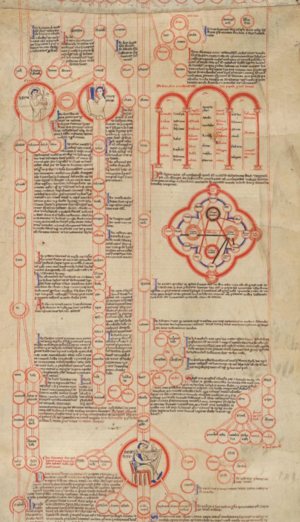
Mittelalterliche Schriftenrolle ©Cambridge Mass., Harvard University, Houghton Library
©Cambridge Mass., Harvard University, Houghton Library
Duration01.06.2026 - 31.05.2029
 FWF
Weave
Grant amount€ 472.908
UnitDepartment of Digital Humanities
Profile area Uni GrazDimensions of Europe
Core research area of the Faculty 
Principal investigatorMag. Roman Bleier, MA PhD
Project staffChiara Citro, BA.
Annabelle Kienzl, BA.
Jakob Sonnberger, BA
Project homepagehttps://gams.uni-graz.at/chigc

Begin of page section:
Additional information:

University of Graz
Universitaetsplatz 3
8010 Graz
Austria
  • Contact
  • Press & Media
  • Moodle
  • UNIGRAZonline
  • Imprint
  • Data Protection Declaration
  • Accessibility Declaration
Weatherstation
Uni Graz
University of Graz part of Arqus.

End of this page section. Go to overview of page sections

End of this page section. Go to overview of page sections

Begin of page section:

End of this page section. Go to overview of page sections