Franciscans as early capitalists?
Tanja Skambraks combines research, teaching and public relations in her work in order to not only shed light on historical topics such as poverty and economic history from an academic perspective, but also to make them socially relevant and tangible.
Microfinance in the Middle Ages
One focus of Tanja Skambraks' research is the social and economic history of the Middle Ages, in particular poverty and poverty reduction. Here, she has focused on medieval pawnbroking banks (Monti di Pietà). These were founded – which may come as a surprise to many – by the Franciscans in order to be able to grant small loans to those in need. Ms Skambraks describes the Franciscans as a fascinating order that developed innovative economic and ethical concepts despite its commitment to poverty and modesty. She particularly emphasises the role of Petrus Johannes Olivi and other Franciscan thinkers who viewed capital as something productive and thus anticipated early capitalist ideas.
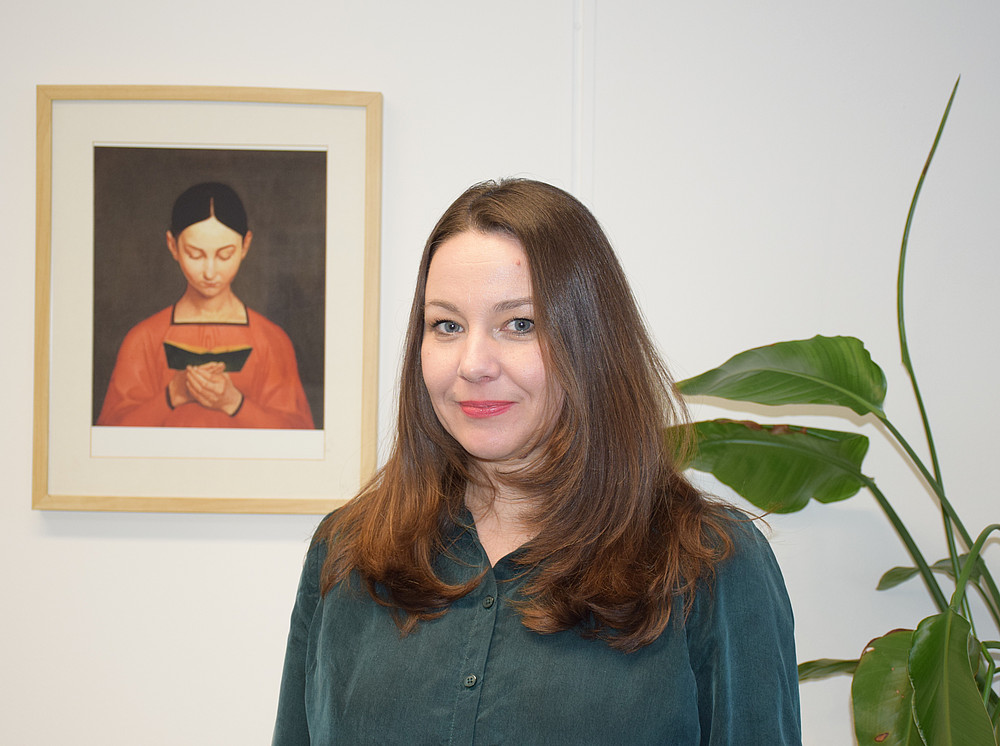
According to Tanja Skambraks, pawnbrokers were not only a means of combating poverty, but also embodied moral and social values that are still relevant today. The connection to modern concepts such as microfinance (including microloans) shows how historical approaches to supporting people in precarious situations can also be applied in the present day.
Object stories
Tanja Skambraks is currently researching medieval objects. Together with colleagues from Salzburg and Kiel, she has just written the book The Medieval Economy in 50 Objects (Routledge). The volume is aimed at a broad audience and uses material culture, such as medieval shoes, spindle weights and coins, to explain the medieval economy in a vivid way. The historian emphasises that such objects not only make trade routes and production conditions tangible, but also the everyday lives of people in the Middle Ages. For example, a counting table was used by merchants and city councillors to calculate income and expenditure. In the Middle Ages, calculations were not yet done using Arabic numerals, but rather Roman numerals, and these were calculated using counting stones on lines along the table. The counting table was not only a practical tool, but also an expression of economic organisation and the importance of accounting for public and private institutions. It connects the history of money with the history of trade and mathematics, thus demonstrating how interdisciplinary the study of such objects can be.
Perspectives on poverty
The exhibition "A Good Life for All – A Historical Perspective" is currently on display at the University Library in Graz. This is an exhibition by Caritas to mark its 100th anniversary, which has now been given additional historical context by historian Tanja Skambraks. This is done through a total of eight audio stations from the perspective of those affected, which were developed by the historian's master's students.
These stations are based on personal accounts from the Middle Ages that shed light on the living conditions and, as Tanja Skambraks emphasises, the survival strategies of poor people. In addition, topics such as hospitals, mendicant orders and pawnbrokers are covered in order to illustrate the historical fight against poverty. The exhibition aims not only to highlight the parallels between the past and the present, but also to raise awareness that poverty is a universal and timeless phenomenon that should not be stigmatised.
As can be seen in the current exhibition, Tanja Skambraks is committed to making historical topics accessible to a broad public in a vivid way. In addition to the exhibition with students, she has also implemented other formats, such as podcasts and an online exhibition about seals. In this way, she combines research-led teaching with practical projects to teach students professionally relevant skills.
Tanja Skambraks studied history, English and communication sciences in Dresden and at the University of Edinburgh before completing her doctorate at the University of Mannheim in 2014. For her habilitation thesis Karitativer Kredit. Die Monti di Pietà, franziskanische Wirtschaftsethik und städtische Sozialpolitik in Italien (Charitable Credit: The Monti di Pietà, Franciscan Economic Ethics and Urban Social Policy in Italy) (2021). Her book on charitable credit was awarded the Datini Society's Human Solvency Prize in 2024. Since 2023, she has been Professor of Medieval History at the University of Graz.