Of aesthetics and free will
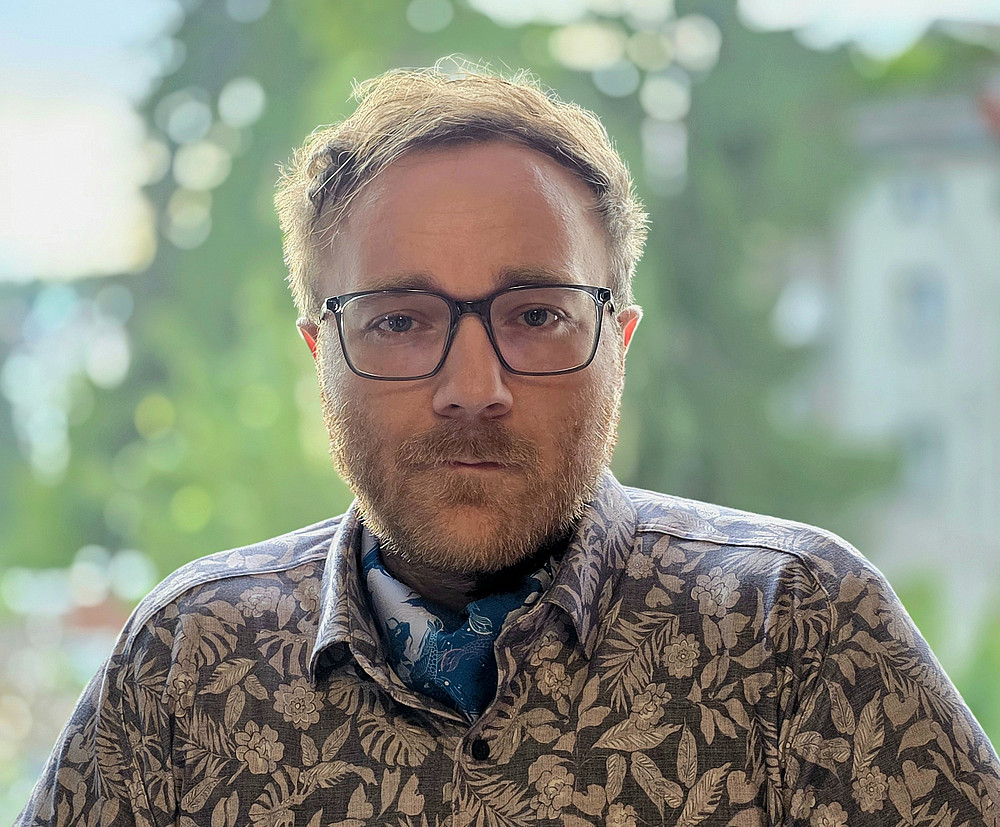
Are we free to decide? What is beautiful? What is pleasure? Michael Schmidt, university assistant at the Centre for the History of Science, devotes his research to these questions in the context of Kant's reception in the late 18th century.
Michael Schmidt is mainly concerned with Immanuel Kant's philosophy and its early reception in German-speaking countries at the end of the 18th century. He focuses in particular on the German-Austrian Enlightenment philosopher Karl Leonhard Reinhold (1757-1823), who was instrumental in the popularisation of Kant's critical philosophy. What particularly fascinates Schmidt about Reinhold is the flexibility of his thinking and the tireless and radical questioning of his own positions, which sometimes led to Reinhold being ridiculed by his contemporaries for his subsequent changes of position.
On the nature of pleasure
Michael Schmidt's master's thesis already dealt with Reinhold's thinking. In Karl Leonhard Reinhold's Theory of Pleasure: Constellations between Ernst Platner and Immanuel Kant, he analyses Reinhold's aesthetic writings, using his essay "On the Nature of Pleasure" as a central source. Schmidt analyses Reinhold's approaches in comparison to other philosophers such as Jean-Baptiste Dubos, Louis-Jean Lévesque de Pouilly and Ernst Platner. He comes to the conclusion that Reinhold had independent and innovative ideas in aesthetics that should be given greater attention and recognition.
The theory of the will and instincts
The fascination that Reinhold exerts on Michael Schmidt has by no means diminished after this first work. In his dissertation project entitled "Karl Leonhard Reinhold's Transcendental-Voluntarist Event-Causal Compatibilism", he focusses on his theory of free will and drives. Schmidt pursues two approaches: one from the history of philosophy and one from the history of science. The history of science encompasses not only the natural sciences, but also the development of the humanities. In the 18th century, there were largely no independent disciplines such as anthropology and psychology; these topics were mostly dealt with philosophically. In Reinhold's theory of free will, the connection between psychological and philosophical approaches becomes particularly clear. Schmidt works out that Reinhold - influenced by the theories of the physician and philosopher Platner - develops his own drive theory, which, in contrast to Kant, plays an essential role in his theory of free will. For Michael Schmidt, Reinhold's approach to the problem of free will is exciting because he is less concerned with whether the existence of free will can be theoretically justified or not. Rather, Reinhold focuses on whether and to what extent we can conceptualise ourselves as free and morally responsible persons - i.e. how and whether we can implement our will in concrete actions/decision-making processes in the empirical world.
Michael Schmidt studied psychology and philosophy at the University of Graz. He completed his Master's degree in Philosophy in 2023 with a thesis on 18th century aesthetics, which was published in 2024 under the title The Aesthetics of Karl Leonhard Reinhold: Transcendental Philosophical Criticism of Taste before Kantpublished by De Gruyter in the Reinholdiana series. Since February 2025, Michael Schmidt has been an assistant professor at the Centre for the History of Science, where he is writing his dissertation under the supervision of Centre Director Simone De Angelis.