Of Viennese strizzis, secret services and mountains of files
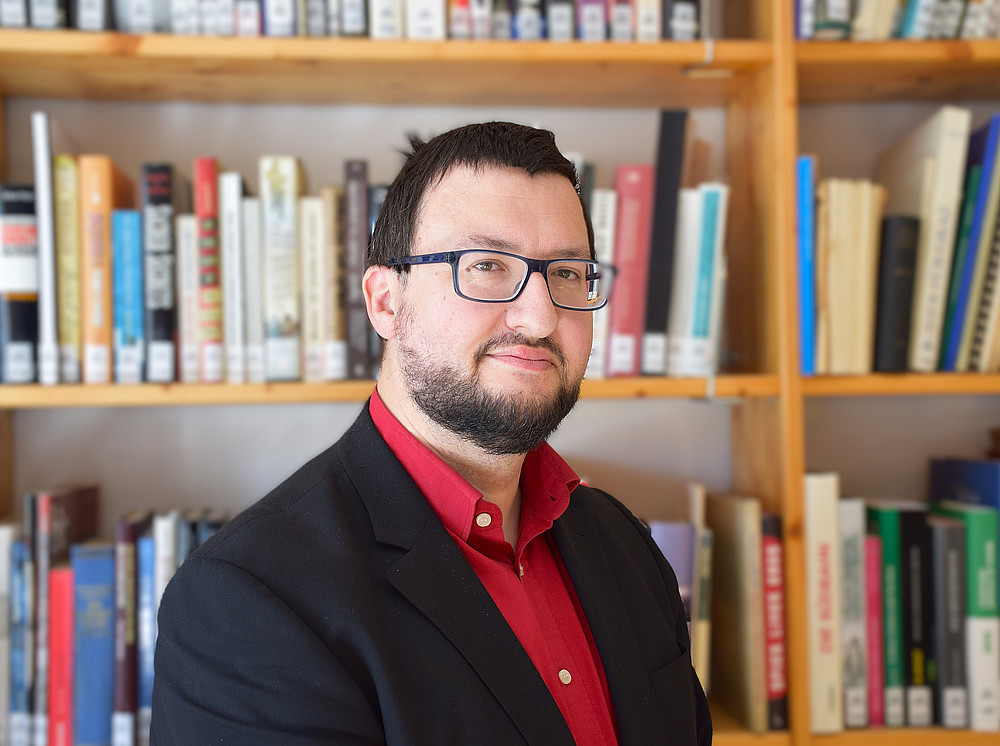
How "secret" were and are secret and intelligence services really and what can we learn today about their activities in Austria during the Cold War? These are questions that Dieter Bacher addresses not only in his research, but also in his role as a science ambassador.
The Egisto Ott affair has brought espionage activities in Austria back into the public eye. However, Austria, and Vienna in particular, has been regarded as a hub for intelligence services from East and West since the post-war period. This is partly due to the country's geographical location and partly due to the diversity of nationalities of its inhabitants, who were often recruited as informants. Vienna was considered a good area of operation, both for reconnaissance and counterintelligence. Austria itself, however, was rarely of interest to the services.
Snatch - Counter Snatch
Dieter Bacher has been researching the activities of secret and intelligence services in Cold War Austria since his student days. In doing so, he repeatedly comes across dramatic biographies, such as that of Maria Subatsch. She worked as a small informant for American intelligence services in post-war Vienna. At the end of the 1940s, she officially disappeared without a trace. Since working on the research project "Shot in Moscow" under the direction of Stefan Karner and Barbara Stelzl-Marx's research on secret services, Bacher has repeatedly focussed on her fate. At the end of a rendezvous with her lover, an Austrian policeman, she was handed over to the Soviet counter-intelligence service (MGB), interrogated for months, sentenced to death for espionage, taken to the notorious Butyrka prison and shot. Years later, her case was also brought up in Austria, the policeman was convicted of kidnapping and eventually took his own life.
A similar case is that of the Viennese strizzi and cigarette smuggler Benno Blum. His files in Washington bear the name "Snatch - Counter Snatch". He was also recruited by the secret services and was eventually killed in a gunfight during a raid by the secret services. Anyone who wants to find out more about Blum's story can do so in a television documentary in which Dieter Bacher participated as an expert. It is expected to be broadcast on ORF 3 at the end of April.
Relatively little is known about the history of the secret and intelligence services and their activities in Austria. However, Dieter Bacher has been fascinated by the subject since his childhood. His dissertation project "The activities of Czechoslovakian intelligence services in Austria from a British and US perspective in the early Cold War" is also concerned with this subject, which he would like to continue researching in the future.
However, this requires a great deal of patience and expertise, as most of the work involves working with files that first have to be located, sifted through and whose information content has to be painstakingly verified and scrutinised. But from Bacher's point of view, the work is worth it. Not only do you gain an insight into historical developments or how decision-making processes took place during the Cold War, but you also learn a lot about the operational methodology of the secret services and how they handle information. And this is, after all, their core business, because the actual profession of the secret services is not to act like James Bond, but to gather and analyse information.
What does science communication have in common with intelligence services?
Bacher is also concerned with the handling of information and sources outside of his research. This is why he is also active as a science ambassador - including through the new BMBWF initiative "Science meets schools".
What exactly is scientific rigour? How does it work? How do I find sources of information? How do I even evaluate information? These are questions that Bacher initially asks in his workshops at schools. In the flood of information that we are exposed to today, it is important to judge which information can be trusted. Quasi intelligence service work. After all, targeted disinformation in particular is becoming increasingly difficult to recognise. Bacher has a guiding principle that he has repeatedly come across in the vast amount of files that he has already sifted through: if there is only one source, then assume that the information is not true.
Dieter Bacher studied history at the University of Graz and is currently writing his dissertation on "The activities of Czechoslovakian intelligence services in Austria from a British and US perspective in the early Cold War" with Barbara Stelzl-Marx. He is a member of the International Intelligence History Association (IIHA) and co-editor of the Journal of Intelligence, Propaganda and Security Studies (JIPSS). His research interests include intelligence services in Cold War Austria and refugees and displaced persons in post-war Austria. Dieter Bacher has been an assistent professor at the Department of History since autumn 2024.