




Romana Königsbrun had already gained experience abroad
while she was still a student.
Originally, Romana Königsbrun wanted to study Chinese and ethnology in Vienna. She had developed an interest in distant cultures at an early age. However, whilst studying for her history A-levels at BG Rein, she realised how much she enjoyed the subject and decided to study history and English and American studies at the University of Graz. Although there were hardly any programmes for semesters abroad during her time as a student in the late 1980s and early 1990s, she arranged a “very enriching” academic year in Oxford through the university’s international office. Later, whilst studying Spanish, she spent a year in Barcelona.
The Graz-born woman first learnt about the Diplomatic Academy from a friend’s sister. “I wrote to them straight away and asked for a brochure – that’s how you used to get information back then, without the internet,” she smiles. “When I’d read the brochure, I was thrilled and knew: language, culture, history… these are exactly my subjects, this is perfect for me.” Romana Königsbrun has now been working abroad for Austria for many years. Management and communication skills are just as essential as good networking. And you have to approach people with an open mind. Her successful career has already taken her to many different countries, though her first posting holds a special place in her heart: “Your first official diplomatic post abroad is certainly something special. I moved to Kenya in 2003 with my husband and our two (at the time) pre-school children and took up the post of Deputy Ambassador in Nairobi. A wonderful time, during which long-standing friendships were also formed.” Romana Königsbrun is currently Ambassador in Pretoria and, in this role, is responsible for South Africa and nine other African countries. “To succeed in this profession, you have to
be a generalist,” she says. “You also have to be prepared to reinvent yourself every four years when a new post with new responsibilities awaits. That also means stepping out of your comfort zone.” Incidentally, whenever she returns from visits home, her luggage is always packed with Styrian specialities: “It’s lovely to offer guests in South Africa Käferbohnensalat with genuine Styrian pumpkin seed oil and fine Styrian wine.” For the guests, it’s something very special; for the ambassador, a little piece of home.
Eva Schlegel, Alumni Magazine 2024 (Alumni University of Graz)
Peter Mikl experienced the feeling of being far from home at an early age: after finishing primary school in Carinthia, he moved to Graz at the age of ten to attend secondary school. A primary school headteacher who was a friend of his father’s had handed him a brochure for what is now known as HIB-Liebenau. In the 1970s, the school took in gifted children (at that time exclusively boys) from rural areas as part of a support programme, to enable them to attend a grammar school. Peter Mikl was gifted and passed the exams of the extensive, three-day admission process. He went to the Styrian capital for his education. “Of course there were wistful moments,” he recalls. “The school was strict and we were only allowed home every other weekend – though the weekends were very short, as we had lessons until midday on Saturdays. But I was proud to have been accepted, and I sensed my parents’ overarching goal: they wanted the best education for me.”
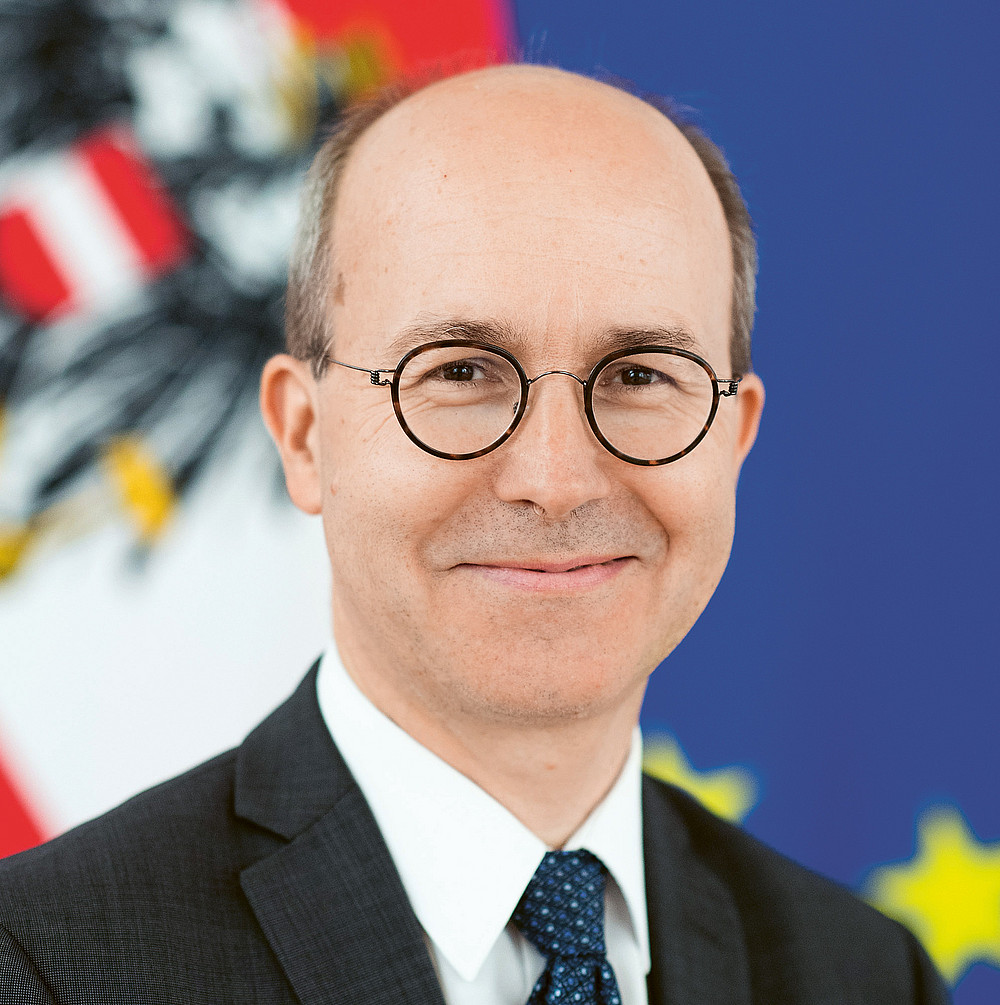
It was at school that the foundations were laid for his later studies in interpreting at the University of Graz: “I was fascinated by the French language. I also used to secretly listen to the radio programme ‘La Chanson’ every week.” Peter Mikl has fond memories of his “Interpreter Training with French” course. “We were a small, close-knit group at the Interpreting Institute in Mariengasse. That meant everything was very hands-on, with plenty of exercises and lots of practical work.” Diplomacy was also already on Peter Mikl’s radar at that time. “The degree gave me the academic qualification needed to apply for admission to the Diplomatic Academy.” The appeal of diplomacy lies in “going out into the world, staying there for longer and being able to take a closer look,” says Mikl. “I’m fundamentally a curious person and like to delve deeper. I don’t just want to spend two or three weeks on holiday in another country, I want to live there.” The diplomat has already “experienced” many cities, including New York, Tel Aviv, London, Manila and Dublin. He liked it best – everywhere. His approach: “I open myself up to every place and to what it has to offer.” For the past two years, he has been serving as the Austrian Ambassador in Tallinn (Estonia). “Tallinn is a digital city, a city with a thriving start-up scene, and offers many cultural events.” This is an aspect that is important to Peter Mikl. He was part of the school drama group and later active in the independent theatre scene in Graz as an actor and director.
Eva Schlegel, Alumni Magazine 2024 (Alumni University of Graz)

Thanks to family ties, Arno Mitterdorfer had been connected to Graz and Styria since childhood. However, the Carinthian-born student chose the University of Graz for other reasons: “During my decision-making phase, the decisive factors for me were both the positive impression I gained of the university as an institution offering a wide range of courses, and the quality of life in Graz as a city that is compact in size yet boasts a rich cultural offering.” Arno Mitterdorfer studied art history and is Director of the Austrian Cultural Forum in Tokyo. His studies have been very beneficial, as he explains: “As well as acquiring knowledge, my studies proved to be an important bridge to professional life, because they allowed – and indeed required – me to hone practical skills in particular. These include, for example, the need for self-organisation, building networks, the interplay of initiative and cooperation, discussion and presentation, and – something quite essential for life – adapting to unforeseen situations and different personalities, which sometimes require you to step out of your comfort zone.”
As Director of the Austrian Cultural Forum in Tokyo, his role is to lead this institution as a hub for Austrian and Japanese cultural practitioners, creative professionals and academics, and as a platform for initiating, planning and implementing joint projects. “What I find wonderful is being able to immerse myself in other societies, getting to know different social customs, and bringing together people from a wide variety of backgrounds from Austria and the respective host country.” In Graz, he was most recently at Eggenberg Palace, home to the valuable Osaka screen. “This is a folding screen from the early 17th century that depicts the Japanese city and life there in incredible detail and represents a highly significant element in cultural relations between Austria and Japan. Especially with a view to 2025, when the World Expo will take place in Osaka.” So far, Arno Mitterdorfer has felt at home at all his postings. However, he suspects and hopes that he would like to spend his twilight years in Austria: “With good connections to the international rail and air transport network.”
Eva Schlegel, Alumni Magazine 2024 (Alumni Uni Graz)