Begin of page section:
Page sections:

  • Go to contents (Accesskey 1)
  • Go to position marker (Accesskey 2)
  • Go to main navigation (Accesskey 3)
  • Go to sub navigation (Accesskey 4)
  • Go to additional information (Accesskey 5)
  • Go to page settings (user/language) (Accesskey 8)
  • Go to search (Accesskey 9)

End of this page section. Go to overview of page sections

Begin of page section:
Page settings:

English en
Deutsch de
Search
Login

End of this page section. Go to overview of page sections

Begin of page section:
Search:

Search for details about Uni Graz
Close

End of this page section. Go to overview of page sections


Search

Begin of page section:
Main navigation:

Page navigation:

  • University

    University
    • About the University
    • Organisation
    • Faculties
    • Library
    • Working at University of Graz
    • Campus
    Developing solutions for the world of tomorrow - that is our mission. Our students and our researchers take on the great challenges of society and carry the knowledge out.
  • Research Profile

    Research Profile
    • Our Expertise
    • Research Questions
    • Research Portal
    • Promoting Research
    • Research Transfer
    • Ethics in Research
    Scientific excellence and the courage to break new ground. Research at the University of Graz creates the foundations for making the future worth living.
  • Studies

    Studies
    • Prospective Students
    • Students
  • Community

    Community
    • International
    • Location
    • Research and Business
    • Alumni
    The University of Graz is a hub for international research and brings together scientists and business experts. Moreover, it fosters the exchange and cooperation in study and teaching.
  • Spotlight
Topics
  • Sustainable University
  • Researchers answer
  • Work for us
Close menu

End of this page section. Go to overview of page sections

Begin of page section:
You are here:

University of Graz Faculty of Humanities Research Stories: Innovation und Inspiration Roth, Schuchter, Bauer
  • Our Faculty
  • People
  • Research
  • Study Services
  • Dean's Office

End of this page section. Go to overview of page sections

Begin of page section:
Sub navigation:

  • Our Faculty
  • People
  • Research
  • Study Services
  • Dean's Office

End of this page section. Go to overview of page sections

A literary view through the lens of Gerhard Roth

Styrian writer Gerhard Roth (1942–2022), who was also a photographic artist, left behind around 60,000 photographs – ranging from everyday moments and landscapes to abstract motifs. He captured life in southern Styria as well as impressions from his travels to America, Egypt and Japan. Many of his photographs appeared in illustrated books such as Atlas der Stille (Atlas of Silence) and Über Land und Meer (Over Land and Sea) or other publications such as Im unsichtbaren Wien (Invisible Vienna) and Spuren (Traces).

The Franz Nabl Institute for Literary Research at the University of Graz has digitised around 40,000 photos from 1977 to 2017 and tagged them with over 200 keywords. The digital photo archive, including information about Gerhard Roth and his works, is available at gams.uni-graz.at/roth. Due to data protection restrictions, a password is required, which can be obtained from the collection's curator at daniela.bartens(at)uni-graz.at.

An interview with Gerhard Roth from 2012 can be found in UNIZEIT magazine.

Scene from rural life in southern Styria: "Woazschälen" (peeling potatoes) ©Gerhard Roth
©Gerhard Roth
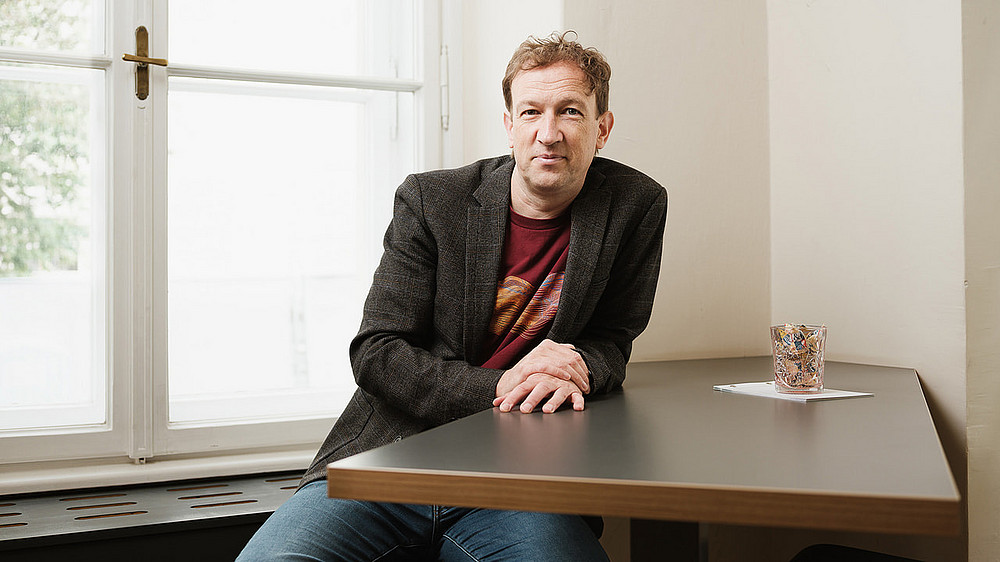
Patrick Schuchter ©Uni Graz/Schaffernak
©Uni Graz/Schaffernak

Palliative work: thinking through to the end

What do people need at the end of their lives – beyond medical and nursing care? As part of the FWF project "Philosophical Practice in Palliative Care and Hospice Work", philosopher and former nurse Patrick Schuchter and his team are researching how philosophical practice can provide support to the dying, their relatives and carers. 

Discussions with those affected focus on exploring questions about life together: Have I lived well? What matters? What comes after death? Participants found the discussions inspiring and relieving. "It is quite obvious that it is not only the body that needs to be cared for, but also the spiritual being," Schuchter summarises. 

The project team is currently working on proposals for integrating philosophical practice into the health and social care system. 

To the Unizeit article (2025)

Reading between the lines

Bernhard Bauer from the Institute for Digital Humanities is examining medieval glosses – marginalia and interlinear notes in manuscripts – in order to research language contact and knowledge transfer in the early Middle Ages. Among other things, he is looking at Old Irish, Old Breton and Old Welsh notes in Latin works such as Priscian's grammar or Bede's calendar treatise. Bauer is particularly fascinated by Irish scribes' personal notes about their everyday lives: "Interestingly, such personal information can only be found in Irish notes." 

Thanks to digital facsimiles and automatic text recognition, transcription can now be done efficiently, but some details still require work on the original. The aim of the Glossit project is to make the paths of knowledge and multilingualism visible. "The glosses show how scholarly communication worked at that time – often across language barriers," says Bauer.

To the Unizeit article (2025)
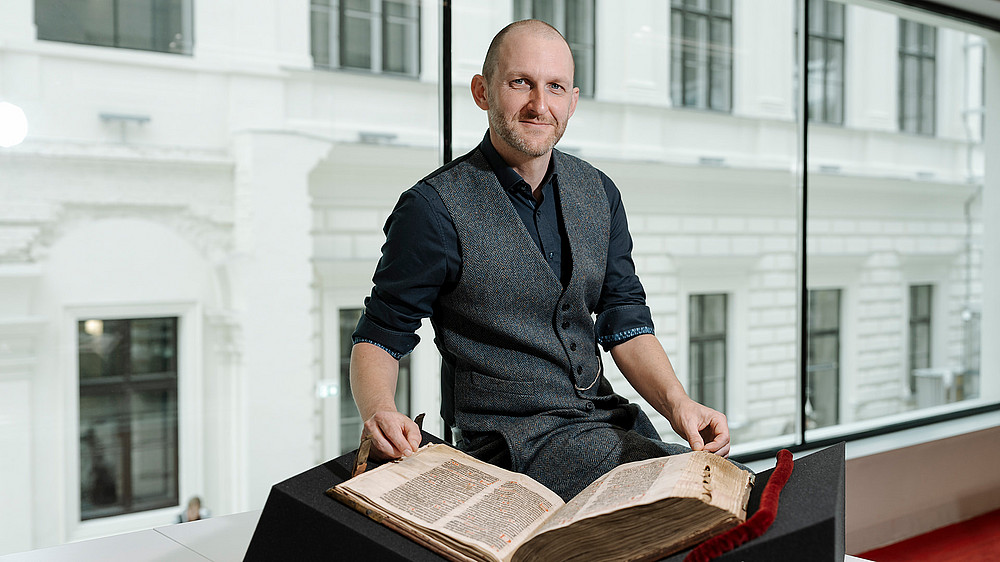
Bernhard Bauer ©Uni Graz/Kanizaj
©Uni Graz/Kanizaj

Begin of page section:
Additional information:

University of Graz
Universitaetsplatz 3
8010 Graz
Austria
  • Contact
  • Web Editors
  • Moodle
  • UNIGRAZonline
  • Imprint
  • Data Protection Declaration
  • Accessibility Declaration
Weatherstation
Uni Graz

End of this page section. Go to overview of page sections

End of this page section. Go to overview of page sections

Begin of page section:

End of this page section. Go to overview of page sections